

ARTICLE 5 | BOARD DECISION-MAKING
The Decision Everyone Supports… Until It’s Time to Own It
CARD EXCERPT
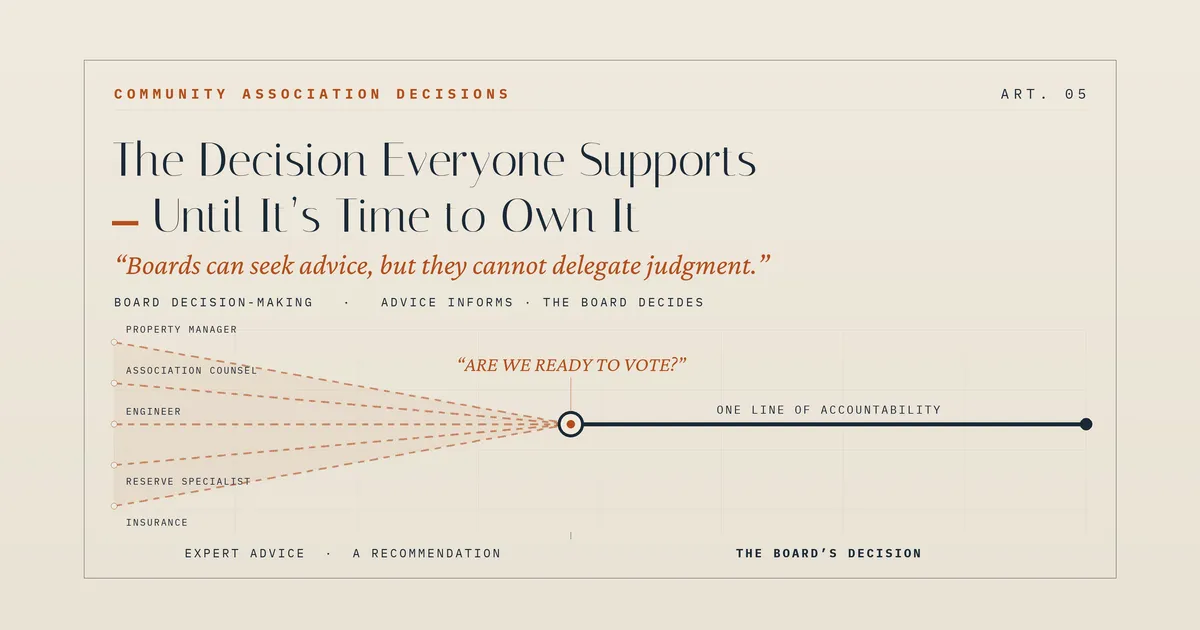
Boards can seek expert advice, but they cannot delegate judgment. The responsibility to decide—and own the decision—remains theirs.
I expected the difficult part of board service would be making hard decisions. I didn’t expect the harder part would be owning them.
One of the biggest surprises I experienced serving on a community association board wasn’t disagreement. It was agreement.
Not because agreement is a bad thing. Healthy boards often reach consensus after thoughtful discussion. What surprised me was how different a decision feels once everyone realizes they’re no longer discussing a recommendation—they’re accepting responsibility for it.
There comes a moment in many board discussions when the conversation quietly changes.
The property manager has shared valuable operational insight. Association counsel has explained the legal considerations. Engineers, accountants, reserve specialists, insurance professionals, and other trusted professionals have contributed their expertise.
The questions have been asked. The discussion has been thoughtful.
Then someone asks, “Are we ready to vote?”
It’s a simple question. But it changes everything.
A board may be deciding whether to move forward with a major capital project, approve a special assessment, address deferred maintenance, adopt a new policy, respond to an unexpected insurance issue, or make another decision that will shape the community for years to come.
The professionals around the table help the board understand the options, the risks, and the implications. But there comes a moment when the recommendation becomes the board’s decision. And once that vote is taken, it becomes part of the community’s history.
I’ve come to believe this is one of the least discussed aspects of board service.
People often assume board decisions are difficult because the issues themselves are complex. Sometimes they are. More often, they’re difficult because there may not be a perfect answer. There are competing priorities. Different risks. Different perspectives.
The board’s responsibility isn’t to make everyone happy. It’s to make the best decision possible with the information available at the time while remaining faithful to its fiduciary responsibilities and the long-term interests of the community.
That responsibility deserves respect.
Serving on a board also deepened my appreciation for the professionals who support community associations. Their expertise is essential to helping boards make informed decisions.
Ultimately, however, boards cannot delegate judgment. They can seek advice. They can ask better questions. They can carefully evaluate competing perspectives. But the responsibility to decide—and to own that decision—remains theirs.
Looking back, I don’t think the strongest boards are those that always agree. I think they’re the ones willing to thoughtfully own the decisions they make, even knowing that not everyone will agree with the outcome.
That is one of the quiet responsibilities of board service. And perhaps one of the reasons it deserves more recognition than it often receives.
Discussion
For those who have served on a board—or who regularly advise boards—when did you first recognize the difference between making a recommendation and owning the decision?

Ritter Governance Advisory, LLC is not a law firm and does not provide legal representation. Governance advisory services do not replace association counsel, property management, or other professional advisors. When serving as a mediator, Francine Ritter acts as a neutral and does not represent any participant.
EXPLORE
LEGAL
Copyright 2026. Ritter Governance Advisory LLC. All Rights Reserved.
Ritter Governance Advisory, LLC is not a law firm and does not provide legal representation. Governance advisory services do not replace association counsel, property management, or other professional advisors. When serving as a mediator, Francine Ritter acts as a neutral and does not represent any participant.
EXPLORE
LEGAL
© 2026. Ritter Governance Advisory LLC. All Rights Reserved.