

ARTICLE 1 | BUDGETING & RESERVE FUNDING
The Most Expensive Promise a Condominium Board Can Make: “We Won’t Raise Fees”
Keeping assessments flat can create the appearance of stability while quietly underfunding a community’s future. The better question is what the budget is choosing not to fund.
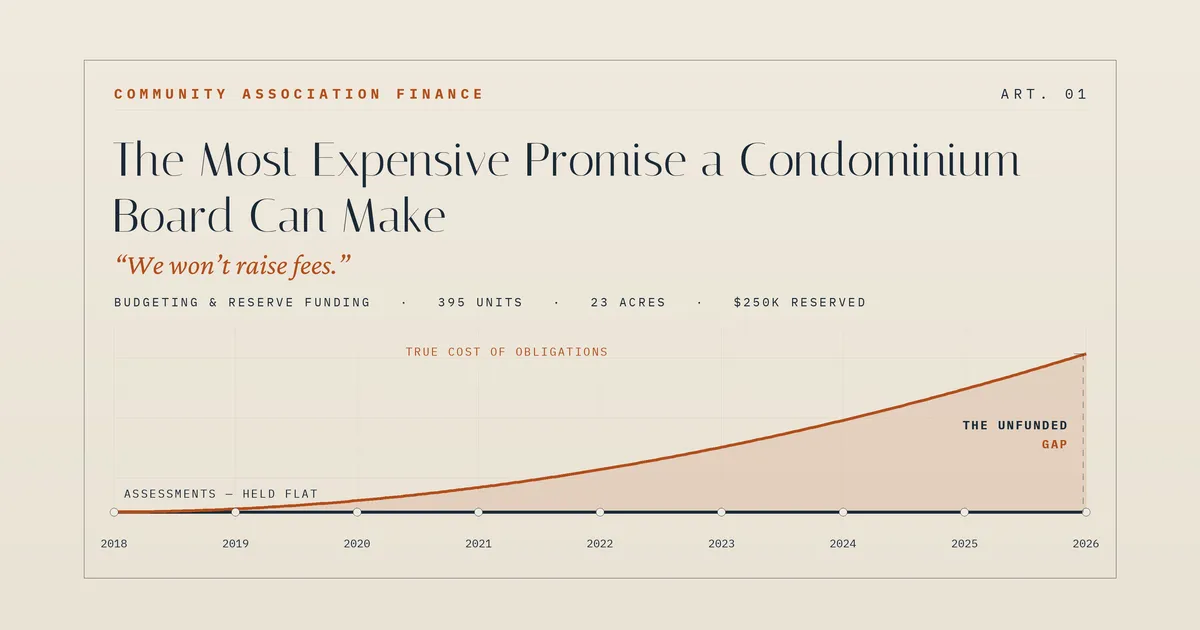
When I joined the board of my condominium community in December 2018, I learned that our 395-unit property, spread across 23 acres, had approximately $250,000 in reserves. The fees had stayed low. The obligations had not.
Owners had become accustomed to assessments that rarely changed. I understand why that was popular. Housing costs matter, and no one welcomes an increase in a monthly bill. But $250,000 was nowhere near enough when measured against the needs of multiple buildings, roads, roofs, water infrastructure, fire-safety systems, common interiors and other components of an aging property.
The low fees created an appearance of financial stability that did not reflect the actual condition of the association.
The Difference Has to Go Somewhere
A condominium association does not have an independent source of wealth. Owners pool their money to pay for the property and services they share.
When insurance, landscaping, snow removal, utilities, labor and professional costs rise, the additional expense must be funded. If assessments remain artificially low, the difference does not disappear. Reserve contributions may remain inadequate. Maintenance may be postponed. Money intended for future projects may be used to pay current expenses. Work that could have been planned gradually may eventually become an emergency.
Keeping assessments artificially low is not necessarily saving owners money. It may simply be borrowing from the association’s future. A future board and a future group of owners will eventually receive the bill.
Low Fees Can Also Produce Low Engagement
The appearance of stability affected more than our finances. Many owners did not attend quarterly meetings, vote in elections or ask detailed questions about the budget and reserves. As long as the fees remained familiar and visible services continued, it was easy to assume that everything was fine.
I do not raise this to criticize those who served before us. The broader lesson is that low assessments can pacify a community while concealing the consequences of underfunding its future.
A low assessment is not automatically evidence of good governance. A higher assessment is not automatically evidence of waste. The real question is whether the amount collected honestly reflects what it costs to operate, maintain and preserve the property.
What Responsible Budgeting Required
Our board examined the association’s bank and investment accounts, contracts, insurance, vendors, audited financial statements and engineering needs.
We obtained an updated reserve study and additional engineering advice. We increased regular reserve contributions, imposed a revised emergency assessment for necessary work and conservatively invested funds that were not immediately needed.
We also disclosed significant contracts, project updates, account balances, reserve and investment information, engineering findings and financial comparisons.
The assessment increases were not popular. Transparency did not make them popular. It did, however, allow owners to understand why the money was needed and where it was going.
Over time, the association completed substantial projects while building its reserves from approximately $250,000 to more than $4 million.
That did not happen because of one assessment or one cost reduction. It resulted from treating the association as a continuing institution whose obligations extended beyond one budget, one board term or any individual owner’s expected time in the community.
The Mortgage Market Is Raising the Standard
Reserve funding can also affect whether units remain financeable and marketable.
For applicable condominium project reviews beginning January 4, 2027, Fannie Mae and Freddie Mac will increase the minimum budgeted allocation for replacement reserves from 10% to 15% of annual assessment income. A qualifying reserve study may provide an alternative, subject to the newer funding standards. Fannie Mae’s March 2026 lender letter explains the change. Sources: singlefamily.fanniemae.com and guide.freddiemac.com.
An underfunded association may therefore affect more than the condition of the property. It may affect whether purchasers can obtain conventional financing, whether current owners can refinance and how readily units can be sold.
As calendar-year communities enter budget season, boards should resist treating an unchanged assessment as the primary measure of success.
Owners should ask what the proposed budget funds, what it postpones and whether reserve contributions reflect the property’s actual future needs.
A responsible budget will not always be the most popular budget. The better measure is whether it pays honestly for the community owners share.
When your board says it can keep fees flat, ask one more question:
What are we choosing not to fund?

Ritter Governance Advisory, LLC is not a law firm and does not provide legal representation. Governance advisory services do not replace association counsel, property management, or other professional advisors. When serving as a mediator, Francine Ritter acts as a neutral and does not represent any participant.
EXPLORE
LEGAL
Copyright 2026. Ritter Governance Advisory LLC. All Rights Reserved.
Ritter Governance Advisory, LLC is not a law firm and does not provide legal representation. Governance advisory services do not replace association counsel, property management, or other professional advisors. When serving as a mediator, Francine Ritter acts as a neutral and does not represent any participant.
EXPLORE
LEGAL
© 2026. Ritter Governance Advisory LLC. All Rights Reserved.