

ARTICLE 2 | MEDIATION & CONFLICT RESOLUTION
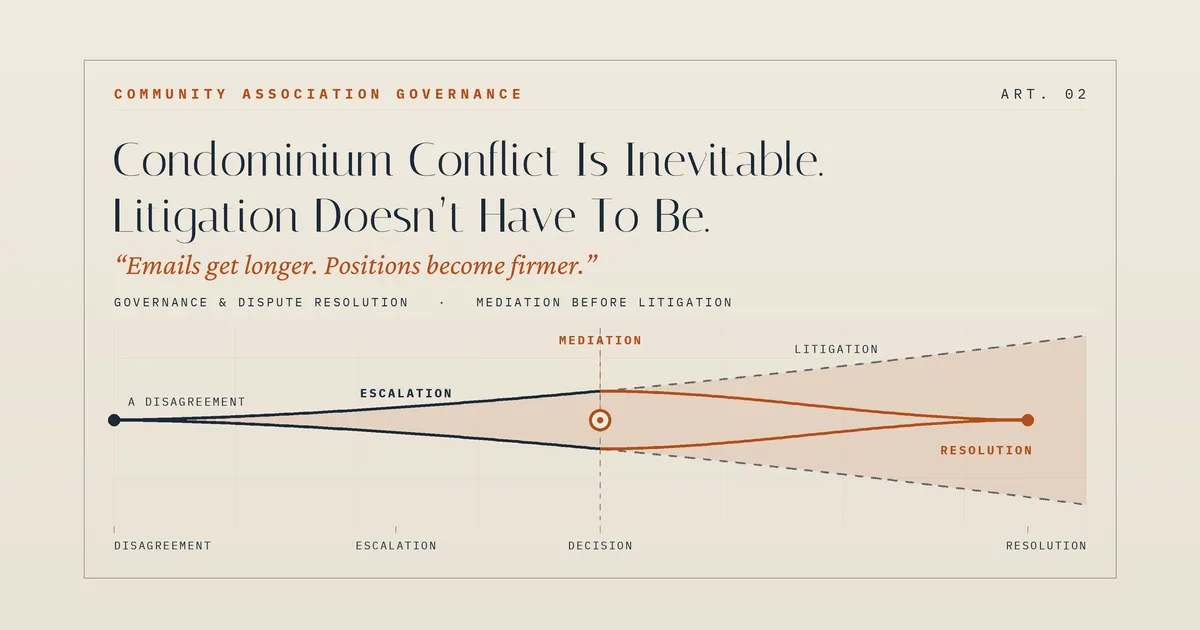
Condominium conflict is inevitable. Litigation doesn’t have to be.
CARD EXCERPT
Condominium disputes rarely start as major disputes. Mediation can help boards and owners find a practical way forward before conflict becomes a legal battle.
Condominium disputes rarely start out as major disputes. More often, they start with a disagreement that no one is quite able to resolve.
Maybe it is over responsibility for a repair. Maybe it is an assessment, a rule, a capital project or a decision an owner believes is unfair. Sometimes the underlying issue is relatively small, but the frustration surrounding it grows.
Emails get longer. Positions become firmer. People stop listening to each other. Before long, the dispute has taken on a life of its own.
Having spent years on a condominium board, including more than four years as president, I learned that one of the hardest parts of governing a community is recognizing when a disagreement is no longer going to resolve itself.
Waiting does not necessarily make it better. Sometimes it simply gives everyone more time to become invested in being right.
That is where I think mediation can be enormously valuable.
Condominium and HOA disputes are different from many other disputes because, when they are over, the parties usually do not go their separate ways. The owner still lives in the community. The board still governs it. Everyone continues to share the same property, expenses and long-term interests.
Preserving the ability to function together matters.
Private mediation gives people an opportunity to get out of the cycle of accusation and response and back to the actual problem. It allows a neutral third party to help identify what is really driving the dispute, where there may be room for agreement and whether there is a practical resolution that everyone can live with.
There will always be matters that require lawyers, and mediation is not a substitute for legal advice. But not every disagreement needs to become a legal battle before the parties sit down and seriously try to resolve it.
That belief is also why I recently added independent private mediation to the work I do through Ritter Governance Advisory for condominium and HOA matters in New Jersey and New York.
To me, it fits naturally with good governance. Sometimes bridging the governance gap means helping people find a way forward before the disagreement becomes the crisis.
I would be interested to hear from board members, managers and community association professionals:
At what point do you think a condominium dispute becomes harder to resolve than the original problem itself?

Ritter Governance Advisory, LLC is not a law firm and does not provide legal representation. Governance advisory services do not replace association counsel, property management, or other professional advisors. When serving as a mediator, Francine Ritter acts as a neutral and does not represent any participant.
EXPLORE
LEGAL
Copyright 2026. Ritter Governance Advisory LLC. All Rights Reserved.
Ritter Governance Advisory, LLC is not a law firm and does not provide legal representation. Governance advisory services do not replace association counsel, property management, or other professional advisors. When serving as a mediator, Francine Ritter acts as a neutral and does not represent any participant.
EXPLORE
LEGAL
© 2026. Ritter Governance Advisory LLC. All Rights Reserved.