

ARTICLE 4 | GOVERNANCE OVERSIGHT & RISK
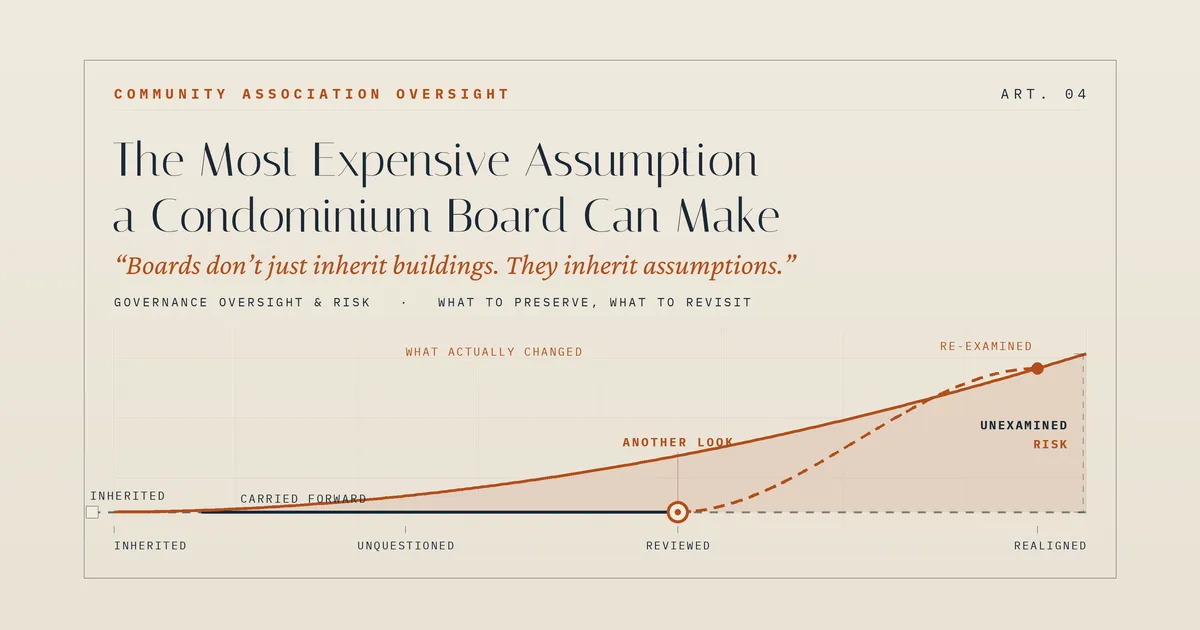
The Most Expensive Assumption a Condominium Board Can Make
CARD EXCERPT
Governance failures often begin with assumptions no one challenges. Strong boards know when an inherited practice deserves another look.
People often assume governance failures begin with bad decisions. That wasn’t my experience.
Serving as a condominium board president taught me that they often begin with assumptions that no one challenges.
When I joined our board, our community had already inherited significant governance and financial challenges. Like many boards, our responsibility wasn’t to revisit the past. It was to understand where we were, strengthen oversight, make thoughtful decisions, and move the community forward.
One lesson became clear to me.
Boards don’t simply inherit buildings. They inherit decisions. They inherit contracts. They inherit policies. They inherit financial practices. And sometimes, they inherit assumptions that no one has questioned for years.
One of the responsibilities of effective board leadership is learning to distinguish between what should be preserved and what deserves another look.
That doesn’t mean questioning everything. It means refusing to accept something simply because it has become familiar.
Throughout my years on the board, I learned that some of the most productive conversations began with simple questions.
Why do we do it this way?
What information are we relying on?
Is this still serving the community’s long-term interests?
Those questions weren’t about criticizing past boards. They weren’t about second-guessing trusted professionals. They were about fulfilling the board’s responsibility to exercise independent judgment.
Property managers, association counsel, engineers, accountants, reserve specialists, and other professionals provide expertise that boards depend on every day. Their perspectives are essential to informed decision-making.
But ultimately, governance requires boards to thoughtfully evaluate that information, ask the right questions, and make decisions they believe are in the best interests of their communities.
Looking back, I don’t believe strong governance is defined by having all the answers.
I believe it’s defined by having the discipline to challenge assumptions before they become expensive mistakes.
Every board inherits a history. Its responsibility is to decide what part of that history should shape the future and what part shouldn’t.
Sometimes the most valuable contribution a board member can make isn’t introducing a new idea. It’s having the courage to respectfully ask whether an old assumption still deserves to guide the next decision.
Discussion
What’s one long-standing practice you’ve seen a condominium board revisit that ultimately led to a better outcome?

Ritter Governance Advisory, LLC is not a law firm and does not provide legal representation. Governance advisory services do not replace association counsel, property management, or other professional advisors. When serving as a mediator, Francine Ritter acts as a neutral and does not represent any participant.
EXPLORE
LEGAL
Copyright 2026. Ritter Governance Advisory LLC. All Rights Reserved.
Ritter Governance Advisory, LLC is not a law firm and does not provide legal representation. Governance advisory services do not replace association counsel, property management, or other professional advisors. When serving as a mediator, Francine Ritter acts as a neutral and does not represent any participant.
EXPLORE
LEGAL
© 2026. Ritter Governance Advisory LLC. All Rights Reserved.