

ARTICLE 3 | BOARD LEADERSHIP & FIDUCIARY JUDGMENT
The Quiet Responsibility Every Condominium Board Member Carries
CARD EXCERPT
Every board decision becomes part of a community’s history. Effective governance depends on sound judgment when competing priorities must be weighed.
During my six years serving on the Board of Trustees—including four years as President—of a 395-unit condominium community, I came to appreciate something that fundamentally changed the way I viewed board service: every board decision becomes part of a community's history.
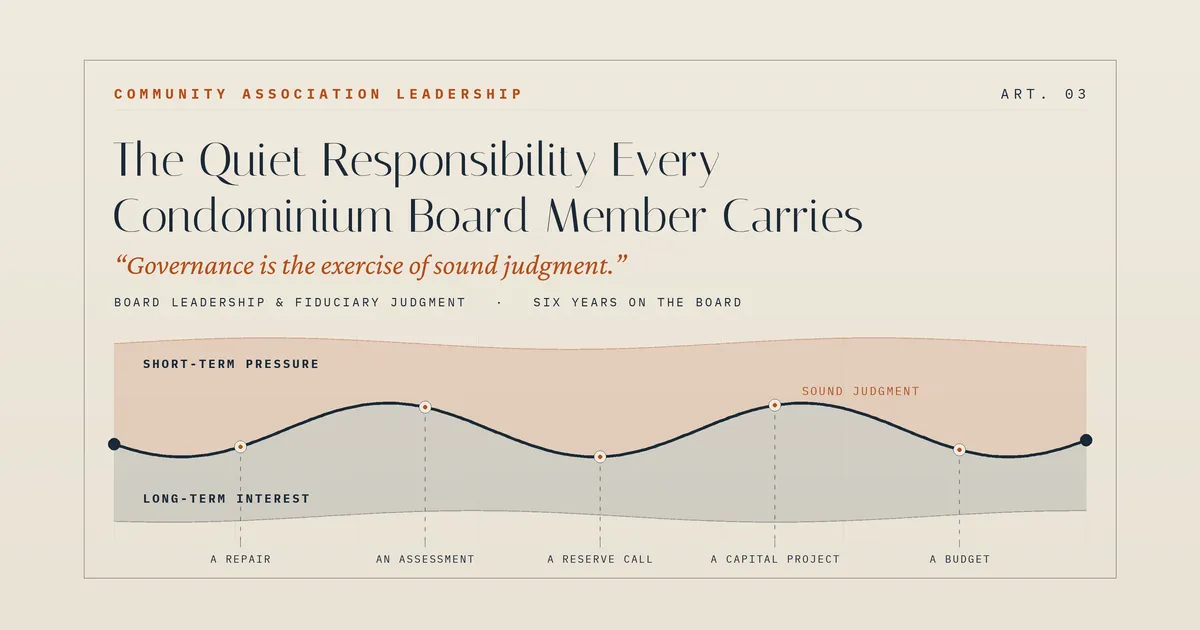
Some decisions are remembered because they solved a difficult problem. Others because they prevented one. Still others because a board had the courage to make a difficult decision when there was no perfect answer. Those moments taught me that governance is about far more than budgets, contracts, or maintenance projects. At its core, governance is the exercise of sound judgment.
Before serving on a board, I assumed governance was primarily about reviewing financial statements, approving vendor contracts, overseeing capital projects, and responding to the issues immediately before us. Those responsibilities are certainly important, but they are not what distinguish highly effective boards.
What ultimately defines board leadership is the quality of the judgment exercised when competing priorities must be weighed and difficult decisions cannot be avoided.
In my experience, boards rarely face a choice between a clearly right answer and a clearly wrong one. More often, they are balancing legitimate but competing responsibilities.
Should a major repair proceed now, or can it responsibly wait another year? Is it better to approve a special assessment today or risk significantly greater costs tomorrow? Should reserve funds be preserved, or invested strategically to avoid more expensive repairs in the future? Should immediate budget pressures take precedence, or should the board remain focused on the community's long-term financial health?
These are not simply financial questions. They are governance decisions because every choice has lasting consequences for homeowners, property values, financial stability, and the future of the community.
One of the most valuable lessons I learned is that thoughtful governance begins long before a vote is taken. Effective boards ask thoughtful questions before they reach conclusions. They challenge assumptions, seek additional information, consider differing viewpoints, and evaluate not only how today's decision will address an immediate issue, but also how it will be viewed years from now.
Good governance is rarely reactive; it is deliberate, disciplined, and forward-looking.
Serving on the board also deepened my appreciation for the professionals who help boards make informed decisions. Property managers provide operational expertise and institutional knowledge. Association counsel offers legal guidance. Engineers, accountants, reserve specialists, insurance professionals, and other advisors contribute technical expertise that strengthens the board's understanding of complex issues. Their counsel is indispensable to effective governance.
At the same time, these professionals do not make the board's decisions. Only the elected board has that responsibility.
The role of advisors is to inform. The role of the board is to exercise independent judgment after carefully considering that advice and determining what best serves the interests of the community.
Looking back, I do not believe effective boards are remembered because every decision proved perfect. They are remembered because they approached difficult decisions with preparation, integrity, humility, thoughtful deliberation, and an unwavering commitment to the long-term interests of the people they were elected to serve.
Every board member casts votes. The best board members recognize that they are also shaping the history their community will inherit. That is the quiet responsibility of governance.
Discussion
What board decision taught you the most about leadership or governance?

Ritter Governance Advisory, LLC is not a law firm and does not provide legal representation. Governance advisory services do not replace association counsel, property management, or other professional advisors. When serving as a mediator, Francine Ritter acts as a neutral and does not represent any participant.
EXPLORE
LEGAL
Copyright 2026. Ritter Governance Advisory LLC. All Rights Reserved.
Ritter Governance Advisory, LLC is not a law firm and does not provide legal representation. Governance advisory services do not replace association counsel, property management, or other professional advisors. When serving as a mediator, Francine Ritter acts as a neutral and does not represent any participant.
EXPLORE
LEGAL
© 2026. Ritter Governance Advisory LLC. All Rights Reserved.